Update2026.11.04 (수)


"Embracing the World with the Deep Metaphors of Christian Literature and the Language of Prayer."

Embracing the World with the Deep Metaphors of Christian Literature and the Language of Prayer
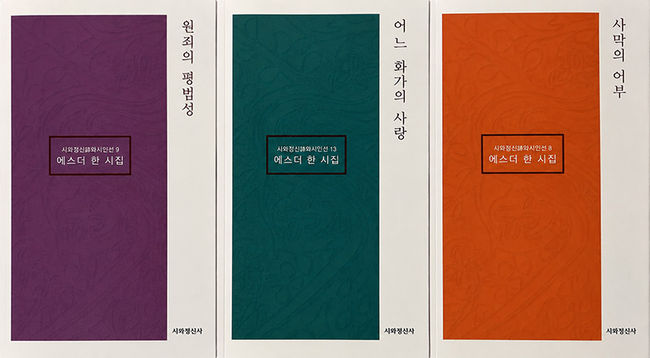
The prophets of the Old Testament invariably heard the voice of God in the wilderness, just as literary masters dredged immortal prose from the depths of absolute solitude. For Dr. Esther Han—pastor, theologian, and poet, who has traced a vast academic trajectory within the Korean-American diaspora—the recent pandemic was precisely such a "wilderness." It was, in a word, a season spent experiencing the "grace of isolation." Had she not been the custodian of a profound spirituality, she might never have endured that bleak interim. Yet, as has always been true, 'prayer' alters the fabric of all things. Through deep intercession and spiritual attunement, she recorded the lines that drifted into her consciousness, one by one. Emerging at last from that tunnel of absolute solitude, she achieved the simultaneous publication of three volumes of poetry: The Fisherman of the Desert, The Banality of Original Sin, and The Love of a Certain Painter (published by Poetry & Spirit).
#. A Missionary Mission of the Written Word Discovered in Isolation
In 2017, after earning her Doctor of Ministry (D.Min.) from Azusa Pacific University, Dr. Han was unexpectedly beset by a cruel, three-year illness that shattered her spirit, soul, and body. The subsequent outbreak of the pandemic seemed only to compound her despair, yet she made a definitive resolve to accept this period as a sacred confinement designed for spiritual renewal. The notes she pressed urgently onto her bedside notepad transformed into metaphors whenever her agony subsided. At the culmination of these birth pangs, three volumes of poetry were born, and, in a turn of events mirroring a miracle, her physical health was restored. Following her recovery, she began to write whenever time permitted. Expanding on her serial columns for the US Chosun Ilbo, she now regularly contributes faith essays to this publication and others, continuing her new calling as a literary missionary awakening the souls of immigrants mired in despair. The agony of crafting a single poem mirrors the fierce journey of her life and literature. Moreover, because her writings are steeped in the social responsibility expected of a Christian, she writes with the perpetual hope that readers will encounter a living, breathing Jesus within her words.
#. The Calling: A Childhood Begun upon a Sickbed, and the Promise to Become a ‘Source of Blessing’
Dr. Esther Han’s life was inherently intertwined with suffering from its inception. Exceptionally frail as a child, she spent far more time confined to a sickbed inside her room than running about the yard like her peers until she reached the age of ten. Yet, paradoxically, that time of solitude gifted her the opportunity to devour a monumental volume of books. Blessed with an extraordinary innate memory, Dr. Han transformed the literature, philosophy, and biblical knowledge she absorbed during her youth into a massive reservoir of life-sustaining nourishment. As an adult, she majored in Food and Nutrition and seemed destined for a stable life as a nutritionist, but her existential angst over why she had to endure such suffering in the bloom of her youth never diminished. Ultimately, pushed to the brink of her physical and mental endurance, she surrendered everything and journeyed to the Osanri Choi Ja-sil Memorial Fasting Prayer Mountain.
Amidst a desperate, life-or-death fast, she heard a still, small voice from heaven. It was the text of Genesis Chapter 12: “I will make you into a great nation, and I will bless you; I will make your name great, and you will be a blessing.” It was the pivot upon which her entire life turned—the moment she received her lifelong mission alongside the absolute assurance that her health would be restored. Nevertheless, with a humble heart that questioned how a mere human could dare to study the Divine through academia, she did not rush immediately to seminary. Instead, she knelt, praying solely that she might "know Jesus Christ more deeply." For three years, she threw her entire spiritual weight into reading and re-reading the Bible until every passage was awakened within her spirit. That season of fierce repentance and voracious reading re-armed her as a true spiritual leader, and finally, in 1982, she was ordained as a lay missionary, taking her historic first steps into the vast mission field of the United States.
#. Academia: Encountering Jesus Christ and ‘Economic Justice’ in the Trenches of Business Administration
Entering the path of formal theological research in the United States in 1990, Dr. Han pursued her Master of Divinity and doctoral coursework at Azusa Pacific University in 1997, aided by the devoted support of faithful helpers, including Missionary Ae-Ri Chang. Given the perennially destitute circumstances of a missionary, sustaining such an extensive academic journey was close to impossible by human calculation; yet, true to the faith that 'where there is a will, a way opens,' the entire process was concluded in grace. However, after completing her doctorate, Dr. Han’s gaze did not remain confined to the theology of the ivory tower.
The more she read the Scriptures, the persistent question that haunted her mind was: "Can the work of the Holy Spirit manifest even in the cutthroat arenas of modern business and management?" To unearth this answer, she once again challenged herself by enrolling in the DBA program in Business Administration at Pacific States University. Wandering through the vast forests of management theory, Dr. Han made the astonishing discovery that Jesus Christ is not only the King within the church walls but also reigns as the 'King of Kings' within the secular marketplace. The Cultural Mandate of Genesis—to 'subdue and rule the earth'—implies that the Divine has distributed opportunity equitably to all humankind. She concluded that to alleviate the chronic disparity between wealth and poverty in modern capitalist societies, Christian entrepreneurs must unconditionally manifest 'Economic Justice' through giving and sharing.
Naturally, her doctoral dissertation converged upon the theme: “GIVING LEADERSHIP:
SOCIAL RESPONSIBILITY OF THE CHRISTIAN BUSINESS OWNER”. What is the Corporate Social Responsibility (CSR) of Christian Business Owners? Once her trajectory was set, the leadership and entrepreneurship of contemporary business titans—such as Jack Welch, Peter Drucker, and Bill Gates—began to be reinterpreted through the rigorous filter of 'Christian Social Responsibility.' Because this academic milestone was achieved under superhuman schedules, balancing full-time ministry with secular work while sleeping a mere two to three hours a night, the sense of fulfillment was beyond measure.
#. Literature: “Singing of Jesus, Who Came as a Homeless Stranger”
In truth, her literary origin lay not in flamboyant rhetoric, but in the 'memos' she recorded during the most painful junctures of her existence. In the early half of 2018, as she watched her aging mother battle illness, the heartbreaking, sorrowful emotions she scribbled into her notebook became the genesis of her poetic inspiration. Her literary mentor, the Pastor Young-Joon Koh, once lauded Dr. Han’s poetry, calling it “simultaneously the poet’s inspiration, the truest companion of the soul, and an alter ego reflecting life itself.” Her poetic universe remains fiercely rooted in the essence of Christian literature.
“Many of my poems give shape to Jesus Christ, who came to this earth in the lowest, most destitute guise of the homeless,” Dr. Han explained. “At the same time, I agonized to unravel through literary metaphor the painful, dark social ailments of the era we stand upon, rather than averting my eyes.” Her first volume, The Fisherman of the Desert, draws its motif from the biblical mandate to 'become fishers of men.' Through the language of prayer, she captures the trials and anxieties of humans struggling within a barren immigrant society and a desert-like world, tracing the spiritual journey of ultimately transcending those hardships through faith.
Her second volume, The Banality of Original Sin, reinterprets the forbidden fruit narrative of Genesis Chapter 3 through a contemporary lens. It indicts a modern world that has grown chillingly numb and indifferent to sin, interrogating the very existence of the Divine. While the vanguard of these poems is saturated with cries of anguish over a darkened world, what remains indelibly stamped upon the reader’s mind as the final page turns is a singular, radiant word: 'Salvation.' Her third volume, The Love of a Certain Painter, lyrically analogizes God’s 'fierce, unrequited love'—poured out unconditionally and unilaterally upon selfish humanity—to an artist's canvas. As expressed in her poem Feeling, which notes that "Love beholds through feeling," she visualizes the invisible love of God through spiritual intuition and literary sensibility.
The essence of Christianity resides in the crown of thorns that must traverse the tunnel of pain, and in the agonizing, blood-stained event of the Cross. Yet, just as the eternal resurrection and the morning of peace arrive only after enduring that sorrowful Friday, our immigrant lives cannot be any different.
“It is my deepest hope,” Dr. Han shared, “that the Korean-American diaspora walking through the deserts of absolute isolation and despair may find healing for their wounds through my humble poetic lines, and that they may encounter the living, working Jesus Christ between the spaces of my sentences, thereby enjoying warm consolation and peace.”
By Reporter Hoon Goo Lee (Editor)